Divisi

A two-to-three-week dry spell in November–February doesn't automatically cost you the season — what decides the outcome is what you do in the next 14 days: where you put your labour and your limited water, and how early you make the calls that matter. Rain has stopped and the sky isn't promising anything soon, but your maize, sorghum or groundnuts are stressed, not dead.
This is the mid-season triage plan for Zimbabwe, Zambia and Malawi farmers whose maize, sorghum or groundnuts are already planted and now facing a dry spell before the next rains return.
How long can maize, sorghum and groundnuts hold on before a dry spell actually costs me yield?
It depends entirely on the growth stage your crop is at when the rain stops — not on the crop alone.
Maize is most vulnerable in a tight window: roughly 10 days before tasselling/silking to 14 days after it, when pollen shed and silk emergence have to line up. Water stress in that window can cut yield by around 50%, against roughly 25% at the vegetative stage and 21% during grain-fill, based on controlled water-deficit trials on maize (Aslam et al., 2020, Scientific Reports; DTN Progressive Farmer). Groundnuts have their own unforgiving window: pegs need moisture in the top few centimetres of soil for around 30 days while they push down and form pods, and a dry spell here can cut pod yield by more than 70% — deep root-zone moisture cannot substitute for dry soil at peg depth (ICRISAT). Sorghum is the most forgiving of the three: it's bred and selected for resilience under limited water and poor soils, and its deeper, more extensive root system buys it several extra days over maize at any stage (ICRISAT).
| Crop | Forgiving window | Unforgiving window | What happens if the dry spell hits the unforgiving window |
|---|---|---|---|
| Maize | Emergence to knee-high (V6–V8) | 10 days before to 14 days after tasselling/silking, and grain-fill | Poor pollination, blank cobs, shrivelled kernels; up to ~50% yield loss at flowering |
| Sorghum | Vegetative growth | Flowering to grain-fill (less severe than maize) | Reduced grain number and weight, but the crop usually still produces something |
| Groundnut | Vegetative growth, before pegging | Pegging through pod-fill (~30 days) | Pegs fail to penetrate dry soil; pods abort; >70% pod loss possible |
(Figures above are sourced from the studies cited in the paragraph directly above this table.)
No-tool field test: dig a 15 cm hole with a hoe near the root zone. Squeeze a handful of soil from the bottom of the hole — if it forms a ball that holds together, there's still usable moisture; if it crumbles and won't hold a shape, the crop is already drawing on its last reserve and you're on the clock.

Photo: Jahra Tasfia Reza / Pexels
I can't water every field — which one do I save first?
Rank fields by two things: growth stage and cost-to-save. Save the field where a small amount of water buys the most yield, not the field that's easiest to reach.
- Maize or sorghum entering the tasselling-to-grain-fill window (see table above) — top priority. This is the highest-value water you'll spend all season.
- Groundnut currently pegging — second priority, especially in the first two weeks after peg-down.
- Any block already showing 30%+ plant loss, severe leaf rolling by mid-morning that doesn't recover by evening, or heavy weed pressure you can't clear — deprioritise. Water is wasted here even if you have it.
- Vegetative-stage crop with no sign of imminent flowering — lowest priority for now; it has days in hand.
If you're weighing whether to invest in irrigation infrastructure at all this season, small-scale irrigation with drip kits or treadle pumps and rainwater harvesting are worth reading before the next dry spell catches you unprepared — but for right now, triage what's already planted.
How do I stop this dry spell from wasting the little soil moisture I have left?
Two actions, both free or nearly free, and both work faster than you'd think.
Mulch immediately, even mid-dry-spell — it's not too late. A 5–10 cm layer of crop residue, dry grass or leaf litter over the root zone cuts soil evaporation and can be the single biggest short-term yield lever available to you: on-farm trials in sub-humid Zimbabwe found mulching outperformed the other conservation-agriculture principles (minimum tillage, crop rotation) for short-term yield protection (Mupangwa et al., Field Crops Research). Use what's on hand: old maize stover, groundnut haulm from a previous plot, cut grass from field margins. Pile it around the base of the plant, not touching the stem, out to the drip line. For the deeper structural fixes — infield basins, permanent mulch cover, minimum tillage — see conservation agriculture for more crop with less rain.
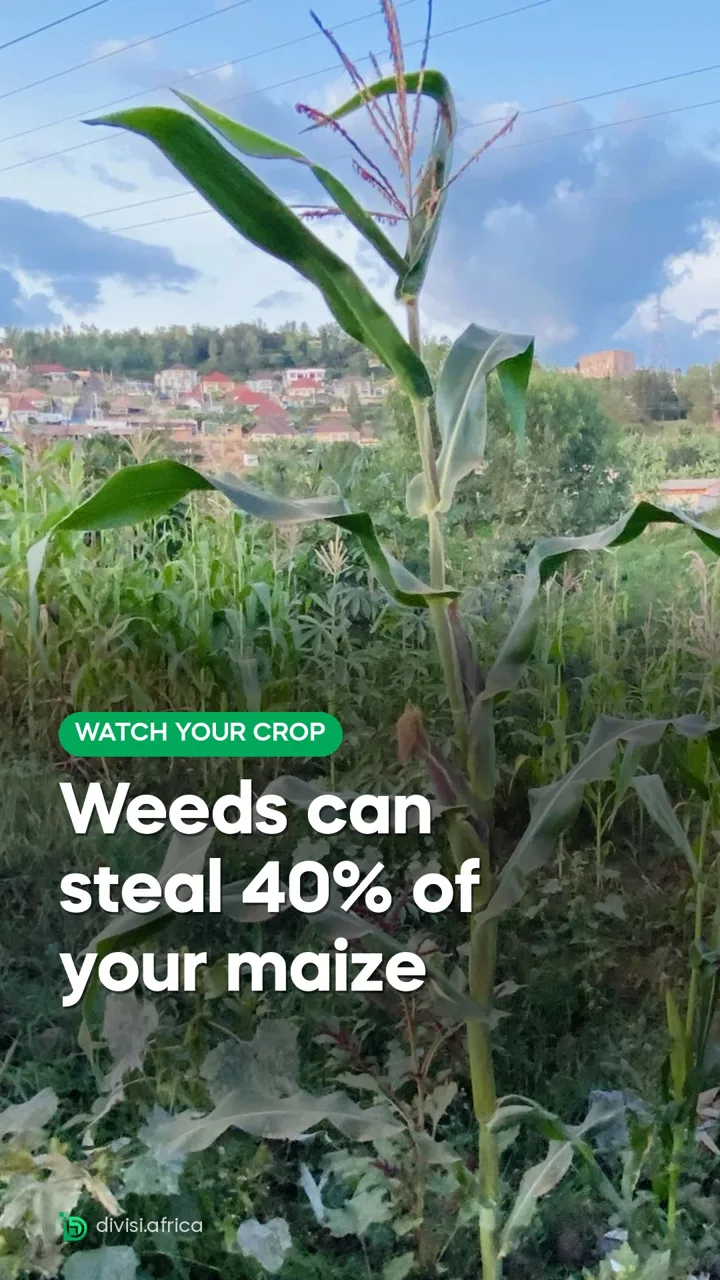
Weed now, not later. Every weed in your field is a second crop drinking the same shrinking soil moisture. A field choked with weeds loses water to weed roots before your maize or groundnut ever sees it — weeding during a dry spell is a water-saving act, not a nice-to-have. Hand-hoe or slash close to ground level; don't wait for the weeds to seed.
Should I top-dress now or hold back until it rains?
Hold back. Nitrogen top-dressing (urea or ammonium nitrate) needs moisture to move into the root zone — applied onto dry soil, it sits on the surface, can scorch roots and leaves in contact, and is at real risk of being lost to volatilisation once rain eventually does come hard. Worse, a well-fed but water-stressed plant still can't use that nitrogen to build yield; you'd be spending money for nothing this fortnight.
The exception: if you can deliver a small, targeted dose of nitrogen with water — a diluted top-dress solution applied directly to the planting station through a watering can or drip line — a light dose can help the plant hold on without the volatilisation risk of dry broadcast application. Otherwise, wait until you have at least 15–20 mm of confirmed rain or irrigation before broadcasting your next dose, and split it into a smaller application to reduce risk if more dry weather follows.
How do I make a small amount of irrigation water go the furthest?
Water only what earns it back — the flowering maize, the pegging groundnut, the sorghum entering grain-fill — and skip everything else this round.
- Deficit irrigation works for maize — but stage decides how much. Maize's sensitivity to water shortfall swings sharply through the season: FAO's yield-response data puts maize's yield response factor (Ky) at only around 0.4 during the vegetative stage but as high as 2.3 at flowering, meaning the same percentage water shortfall costs far less yield before flowering than during it (FAO, Yield Response to Water). In practice: protect flowering and grain-fill fully, and let vegetative-stage crop run a bit drier.
- Apply water to the row, not the field. A jug, watering can or bucket poured at the base of each plant in your priority block beats a shallow sprinkle across a wider area — deep, localised watering reaches the root zone; a light scatter just wets the surface and evaporates by afternoon.
- Water in the early morning or evening, never at midday, to cut evaporation losses.
- Groundnut needs pod-zone moisture specifically — water close to the plant base where the pegs are entering the soil, not just around the canopy edge.

Photo: kaboompics.com / Pexels
If you're building water-saving infrastructure for future dry spells rather than improvising this week, drip kits and treadle pumps cover the equipment side in depth.
When does cutting for fodder beat waiting for a grain harvest?
Cut for fodder when the maize or sorghum has clearly missed its grain-fill window but still has usable green biomass — don't wait for it to dry to nothing first.
Signs it's time to cut rather than wait:
- Pollination has visibly failed (bare or mostly bare cobs) and the dry spell shows no sign of breaking.
- The plant is still green and leafy despite stress — that's still digestible feed value; once it browns off completely, feed quality drops fast.
- You have livestock, a feed bank, or a buyer for green fodder, and grain recovery from this block now looks unlikely even if rain returns soon.
Cutting now for silage or hay salvages real value from a block that would otherwise return nothing, and it's usually a better economic call than gambling more input cost and time on a block that has already lost its grain window. For the storage and feed-banking side of this decision, see fodder and feed banks for livestock in the dry season.
When do I cut my losses and replant something else?
Make the call by growth stage and days-remaining-in-season, not by hope.
Replace the block rather than keep nursing it if:
- Maize or sorghum has failed to establish a stand (less than roughly half the expected plant population emerged and surviving).
- The crop is still vegetative, badly stunted, and more than three weeks behind where it should be for the calendar date — it's very unlikely to reach flowering before the season's effective rainfall runs out in February–March.
- Groundnut pegs have died back with no new pegging after moisture returns — the pod-set window for that planting is gone.
If you decide to replant, go shorter-season, not the same variety again. An early-maturing, drought-tolerant maize variety bred for this region (through initiatives like CIMMYT's Drought Tolerant Maize for Africa programme) can still reach a harvest from a November–December replant, whereas a full-season variety planted late usually can't (CIMMYT DTMA). Sorghum, cowpea or a short-season sugar bean are all realistic swaps if you're moving out of maize entirely for that block. Whatever you choose, check the seed packet's days-to-maturity against how many weeks of reliable rain realistically remain for your area before committing seed and labour a second time.
Your next step this week
Walk your fields today and sort every block into one of three piles — save (flowering/pegging), hold (vegetative, can wait), or salvage/replace (missed its window) — then put your labour and water into the "save" pile first, starting with mulch and targeted watering at the plant base.