Divisi

Floodwater draining away is not the all-clear — it's the starting gun. The heaviest losses in livestock after East Africa's El Niño-driven rains typically land two to eight weeks after the rivers go back inside their banks, once mosquitoes have bred out in the standing pools, pasture has turned into a parasite nursery, and animals that stood in mud for days start showing footrot and pneumonia. ILRI notes that flooding in Ethiopia "not only leads to loss of livestock but also predisposes animals to diseases such as anthrax and vector-borne diseases" — the damage compounds well after the water is visibly gone. This guide covers the six-to-eight week recovery window: what to watch for, what you can treat yourself, and when to get a veterinary officer on the phone.
If you're still draining fields and salvaging crops, see recovering your farm after a flood first. If you're managing feed and water shortage from the dry spell that came before the rains, that's covered in livestock through the dry season and dry-season fodder banks. This piece picks up once your herd is standing on wet ground and the disease clock has started.
Why do my animals get sick weeks after the floodwater has gone down?
The mechanism is straightforward: mosquitoes need standing water to breed, ticks and worm larvae need humidity to survive on pasture, and wet ground itself injures hooves and lungs. Each of those triggers has its own lag time before you see the animal sicken — which is why the danger window runs weeks, not days, after the flood recedes.
How do I protect my herd from Rift Valley fever after heavy rains?
Watch for a spike in abortions and sudden deaths in young stock — that's the first sign of Rift Valley fever (RVF), caused by the Rift Valley fever virus (genus Phlebovirus), and it follows heavy rain almost every time. FAO explains why: "outbreaks tend to occur after periods of heavy rainfall or flooding, which create ideal breeding conditions for mosquito vectors (mainly Aedes, Culex and Anopheles genera)." Aedes mosquitoes lay drought-resistant eggs in low-lying soil that can carry the virus for years; floodwater triggers a mass hatch, and Culex mosquitoes then amplify and spread the virus fast through your herd (FAO).
WOAH records just how brutal an outbreak can be: mortality of 70–100% in lambs and kids, 20–70% in adult cattle and sheep, and abortion in 80–100% of pregnant cows and ewes that catch it. In April 2026, FAO and IGAD's regional body ICPALD issued exactly this warning for southern Kenya, Tanzania, Burundi, southern Ethiopia, Rwanda and South Sudan's Sudd wetlands, after prolonged rain and flooding raised mosquito habitat across the region — the same pattern repeats wherever heavy rains pool for weeks, including the Kenya–Somalia and Ethiopia borderland.
What to do this week:
| Action | Why |
|---|---|
| Call your veterinary officer before you vaccinate | RVF vaccines are strain- and stage-specific; a live vaccine given to a pregnant animal can itself trigger abortion, so timing needs a professional call (WOAH) |
| Isolate any animal that aborts or dies suddenly | RVF is zoonotic — you can catch it from blood, birth fluids or tissue |
| Wear gloves when handling an abortion, birth or carcass | Protects you while you wait for the vet |
| Report a cluster of abortions or sudden deaths immediately | Early reporting is what stops a herd outbreak becoming a village one (FAO/ICPALD) |
| Don't slaughter or sell a sick or recently-dead animal | Protects buyers and your own household from exposure |
Do not treat a suspected RVF cluster yourself. This is a call-the-vet disease, not a home-remedy one.
Why are ticks, tsetse flies and mosquitoes suddenly everywhere on my farm?
Standing water and thick, wet grass are a vector factory, and three groups explode at once after flooding: mosquitoes (RVF, above), ticks, and — in tsetse-belt areas of Uganda, western Kenya and the Ethiopian lowlands — tsetse flies. The tick that carries East Coast fever, Rhipicephalus appendiculatus, breeds fastest in humid, overgrown pasture, and icipe puts the scale of the disease it causes (Theileria parva infection) starkly: "a cow succumbs to East Coast fever every 30 seconds" across the continent, roughly 1.1 million cattle a year. Tsetse flies (genus Glossina) that transmit trypanosomiasis follow the same pattern — a study in Loka Abaya, southern Ethiopia, trapped tsetse at 8.9 flies per trap per day during the wet-humid months and found 8.3% of cattle infected with Trypanosoma congolense and Trypanosoma vivax (academic study, Journal of Entomology and Nematology).
Your post-flood vector playbook:
- Dip or spray weekly, not monthly. Acaricide programmes built for the dry season are too thin now — tick numbers on wet pasture can outrun a monthly dip.
- Check ears, tail switch, udder and between the legs daily — the soft-skin spots ticks favour. A hand-run check takes two minutes per animal and needs no tools.
- Slash or graze down long grass around kraals and water points. Ticks quest from grass tips; short grass means fewer bites.
- Move night kraals away from standing water and thicket where mosquitoes and tsetse concentrate.
- Watch for the trypanosomiasis triad — fever, weight loss and swollen lymph nodes under the jaw or in front of the shoulder — and call your vet for a blood smear before you buy a trypanocide; treating the wrong parasite wastes money and delays real treatment.
If tick loads or fly worry seem worse this year than last, it isn't your imagination — wet, humid pasture is measurably worse vector habitat than dry pasture.
My animals are limping — how do I treat and prevent foot rot in wet ground?
A cow or goat pulling up lame after days on saturated ground is very likely footrot, an infection driven by the bacterium Fusobacterium necrophorum, often alongside Dichelobacter nodosus, that gets into skin softened by prolonged standing in mud or water. Left untreated it can spread from the interdigital skin into the joint and take an animal permanently off its feet.
Field diagnosis (no tools needed): press gently between the claws — heat, swelling and a foul smell mean footrot; a swollen single claw with no smell is more likely a puncture or abscess and needs a different fix.
What you can do yourself:
- Move affected animals to the driest ground on the farm immediately — footrot cannot heal while the foot stays wet.
- Wash the foot clean of mud and manure, then examine between the claws for the telltale smell.
- A footbath of dilute zinc sulphate or copper sulphate solution (ask your local agrovet stockist for the mixing ratio — concentration varies by product) run through 2–3 times over a week catches early cases.
- Keep the treated animal on dry bedding or a raised, dry pen until it's sound.
Call a veterinary officer if: the animal is not weight-bearing at all, the swelling has moved up the leg, more than one in ten animals in the herd is affected at once (a footrot outbreak needs a herd-level plan, not one-by-one treatment), or the lameness hasn't improved after a week of footbaths.
How do I protect my herd from liver fluke, worms and moldy feed after a flood?
Flooded pasture breeds three separate threats to a gut and liver that was already under strain from the rains: liver fluke, gut worms, and mould in any stover or hay that got wet. Treat all three as part of one post-flood deworming and feed-safety pass, not three separate problems.
Liver fluke. Fasciola gigantica, the liver fluke common across East Africa, needs an aquatic snail as an intermediate host — exactly what a flooded, slow-draining paddock provides. Infection takes 10–16 weeks to mature inside the animal (Merck Veterinary Manual), so animals grazing flooded ground now can start showing weight loss, poor coat and bottle jaw (fluid swelling under the chin) two to three months later — plan a flukicide dose with your vet around that window rather than waiting for symptoms.
Internal parasites. Standing water and warm, humid ground favour worm larvae surviving on pasture far longer than in a dry season. If you dewormed before the rains, don't assume you're covered — repeat the dose 6–8 weeks after the flood, timed with your vet or agrovet to match the parasites active in your area.
Feed spoilage and mycotoxins. Any maize stover, hay or silage that got wet and wasn't fully dried before storage is now a mould risk. Moulds including Aspergillus flavus produce aflatoxin, which damages the liver and suppresses immunity in livestock at the exact moment disease pressure is highest.
No-tool field test for spoiled feed: smell and look before you feed it out. Musty smell, visible grey-green or black mould, caking, or heat coming off a stack when you push your hand in are all reject signals — don't feed it, even diluted with clean feed. For grain-based feed, the same bite test used for human-grade maize applies: kernels that dent easily under a thumbnail, rather than cracking cleanly, are too wet to store safely.
How do I keep my animals' drinking water clean, and stop pneumonia in this wet, cold spell?
Water. Flooded rivers, shallow wells and open pans pick up manure, carcasses and agrochemical runoff, turning a normal water point into a source of diarrhoea, liver fluke snails and other waterborne disease. Where you can, water animals from a protected borehole or a raised trough filled from a cleaner source rather than letting them wade into and drink from the same flood pool they're standing in. If a raised trough isn't possible, let floodwater in an open pan settle for 24–48 hours and draw from the top, away from sediment, and keep animals from standing directly in their own drinking source — fence off the water point and let them approach from one clean side only.
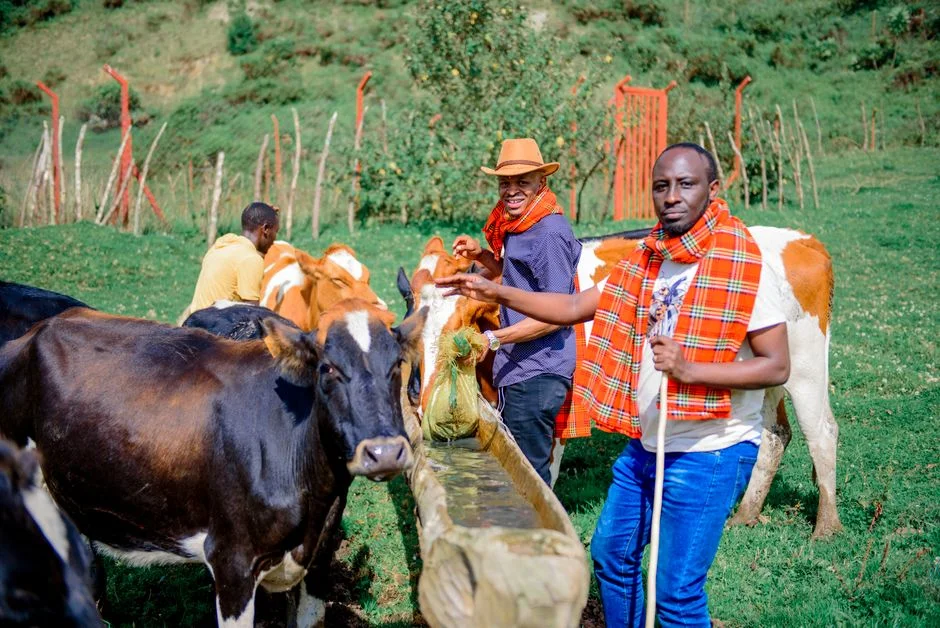
Photo: Justin Muhinda / Pexels
Pneumonia. Cold nights, wet coats and draughty, waterlogged shelters are exactly the conditions that let bacteria such as Mannheimia haemolytica and Pasteurella multocida — normal residents of a healthy animal's airway — turn into pneumonia once the animal's defences are run down by cold and damp (Merck Veterinary Manual). Watch for coughing, fast or laboured breathing, a runny nose and animals that stand apart from the herd with their head low.
This week's shelter checklist:
- Roof and walls that keep the prevailing wind and rain off the sleeping area — even a simple reed or iron lean-to matters more than open pasture right now.
- Raised, dry bedding — even a layer of dry grass on top of mud cuts a lot of chill.
- No draught at animal-height, even if the shelter is otherwise open.
- Young, old and thin animals sleep under cover first if space is limited — they carry the least reserve against cold stress.
A mild cough that clears in a day or two and doesn't come with fast breathing can usually be watched. Laboured breathing, a temperature you can feel is hot to the touch, or more than one animal going down with the same signs within days of each other is a call-the-vet situation — bacterial pneumonia in a wet, cold herd can move from one sick animal to a serious outbreak within a week.
How do I score body condition and know when to call a vet versus treat it myself?
Body condition score (BCS) is the fastest no-tool way to catch weight loss before it becomes an emergency, and after a flood you should be scoring weekly, not monthly. Run a hand along the backbone, ribs and hip bones of cattle or goats and score on a simple 1–5 scale:
| Score | What you feel |
|---|---|
| 1 – Very thin | Backbone and ribs sharp and visible, no fat cover, hip bones prominent |
| 2 – Thin | Ribs easily felt with light pressure, backbone still prominent |
| 3 – Moderate | Ribs felt with firm pressure only, backbone smooth, this is the target range |
| 4 – Fat | Ribs hard to feel, backbone rounded |
| 5 – Very fat | No rib or backbone felt, fat deposits visible |
A healthy adult beef or dairy animal recovering from a flood should sit around 2.5–3. A drop of a full point in two to three weeks — even if the animal is still eating — is your early warning that disease, not just feed, is behind it.
Photo: Bemnet Mesfin / Pexels
Vaccination and deworming timing. Ask your veterinary officer to align your post-flood vaccination and deworming calendar around this recovery window rather than the pre-flood schedule you may have already run: RVF vaccination decisions belong entirely with the vet (see above); a repeat deworming dose at 6–8 weeks after the flood catches the worm and fluke burden building on wet pasture; and any vaccine due in the next month is safest given once animals are back to a stable body condition score, not while they're still losing weight.
What you can handle yourself this week:
- Weekly hands-on body condition scoring of the whole herd.
- Moving animals to dry ground, dry shelter and clean water.
- Footbaths for early, single-claw lameness.
- Rejecting visibly mouldy feed.
- Daily tick checks and slashing long grass around kraals.
What needs a veterinary officer:
- Any cluster of abortions or sudden deaths (possible RVF).
- Lameness affecting more than one in ten animals at once.
- Laboured breathing, high fever, or multiple animals going down together.
- Suspected trypanosomiasis (fever, weight loss, swollen lymph nodes) — needs a blood smear before treatment.
- Any animal with bottle jaw, chronic weight loss or scouring that doesn't respond to a first deworming dose.
- Planning your RVF, deworming and vaccine calendar for the recovery window.
If you're restocking or managing goats, sheep and poultry through this same wet stretch, small stock in the dry season and after covers the species-specific detail this piece doesn't repeat.
Your next step this week
Walk your herd today and score body condition on every animal by hand — write the date and score down so next week's check tells you who's declining, and call your veterinary officer the same day for anyone below a 2, any lameness in more than one animal, or any unexplained abortion.